One-Way Vision Window Film: How It Works and Where to Use It
A shopfront window covered edge to edge with a bold printed graphic looks like a billboard from outside — yet step inside and staff can still see the street, sunlight still comes through, and the space doesn't feel sealed off. That's the trick behind one-way vision film: a perforated vinyl that shows a full-color image to the world outside while staying semi-transparent from the inside looking out. It's one of the most widely used printed materials on shopfronts, vehicle rear windows, and glass offices across Bangalore, and understanding how the perforation ratio actually works makes it much easier to choose the right version for a given window or vehicle.
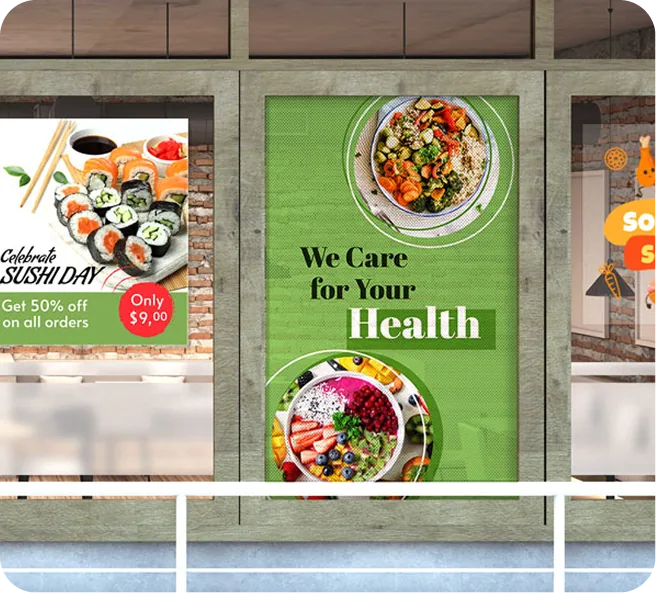
What One-Way Vision Film Is
One-way vision film (also called perforated window vinyl or see-through window film) is a self-adhesive vinyl sheet punched with a uniform pattern of small circular holes across its entire printed surface. The printed, solid side faces outward and carries the full-color graphic, while the holes let light and a blurred view pass through from the unprinted, darker-appearing inside surface. Viewed from outside in daylight, the perforations are small enough and close enough together that the eye blends them into a continuous printed image; viewed from inside, especially with lower interior light than the bright exterior, the same holes let someone see a soft, pixelated view of what's outside. The effect depends on this light-level imbalance — brighter outside than inside — which is why one-way vision film works far better for a daytime shopfront than for a space lit brightly at night with dark streets outside.
How the Perforation Ratio Works
The film's performance is described by its perforation ratio, usually written as print-area-to-hole-area, such as 50/50, 60/40, 65/35, or 80/20. A 50/50 film has the largest holes and the best outward visibility from indoors, making it the common choice for vehicle rear windows and glass doors where staff or drivers genuinely need a clear view through. A 60/40 or 65/35 film balances visibility and graphic sharpness, and is a common default for general shopfront use. An 80/20 film has smaller, denser holes, giving richer, more solid-looking print color and better UV/heat blocking, at the cost of a dimmer, grainier view from inside — closer in feel to a privacy film with a graphic layered over it. There's no universally "correct" ratio; it's a trade-off decided by how much the business needs people inside to see out clearly versus how bold and photographic the outside-facing graphic needs to look.
Materials and Printing Process
The base material is typically a calendered or cast PVC film in the 100–150 micron range before perforation, with perforated versions losing a portion of that area to the punched holes. Printing is done using standard large-format digital processes — eco-solvent, UV-curable, or latex inkjet — the same technology used for vinyl banners and vehicle wraps, so a shop already equipped for large-format signage doesn't need separate machinery for one-way vision film. UV-stable inks are generally recommended for anything facing direct sun for months, since fading on a partially perforated surface can look uneven if the holes and the printed vinyl between them age at different rates. After printing, the film is usually laminated for scratch and UV protection before being applied.
Common Uses
One-way vision film shows up wherever a business wants a large, eye-catching graphic on glass without fully blocking the view or light. The most common applications are shopfront and retail storefront windows (promotions, branding, product imagery visible from the street), office and corporate glass frontages wanting privacy with branding, vehicle rear windows and glass panels for fleet branding and advertising, glass partitions in offices wanting a decorative or branded privacy layer, and bus, train, or transit vehicle windows used for advertising campaigns. In commercial strips across Bangalore — from retail stretches in Koramangala and Indiranagar to glass-fronted offices in Whitefield and Electronic City — one-way vision film is a practical way to use street-facing glass as advertising space that would otherwise sit unused or require blackout coverage.
How to Choose the Right Film
Deciding factors include how much the interior genuinely needs an outward view (favoring a more open ratio like 50/50 or 60/40), how bold and photographic the design needs to look from outside (favoring a denser ratio like 70/30 or 80/20), whether UV and heat-blocking is also a priority (denser ratios block more heat and light), and the surface it will go on — flat shopfront glass is generally easier to apply cleanly than a curved vehicle rear window, which may need a film specifically rated for compound curves. It's also worth confirming lamination and expected outdoor lifespan with the printer, since unlaminated film exposed to direct sun and rain will fade and lift at the edges faster than a properly laminated install.
Installation and Maintenance
Application requires a clean, dust-free glass surface, and the film is applied using a wet or dry squeegee method depending on the adhesive type, working from one edge across to avoid trapped air or water. Curved vehicle glass generally needs more careful heat-assisted application than flat shopfront windows. Once applied, one-way vision film is typically cleaned with a soft cloth and mild, ammonia-free glass cleaner, since ammonia-based cleaners can degrade some vinyl adhesives and films over time. Properly applied and laminated film on a shopfront can generally be expected to hold its color and adhesion for a few years outdoors, though exact lifespan depends on sun exposure, climate, and film quality, and is best confirmed with the specific supplier.
Window graphics like one-way vision film are produced on our HP Latex printing line; for other storefront options, see our signage materials guide.
FAQ( 01 )
Yes, to a degree — the perforated holes let a soft, somewhat blurred view through from the inside, especially when it's brighter outside than inside, which is the typical daytime condition for most shopfronts and offices.
Not as well as during the day. The one-way effect relies on the outside being brighter than the inside; at night, with interior lighting on and the street darker, the visibility can effectively reverse, making the inside more visible from outside.
A 60/40 or 65/35 ratio is a common balanced default for general shopfront use. Choose a more open ratio like 50/50 if clear outward visibility matters most, or a denser ratio like 80/20 if bold, solid-looking graphics and more UV/heat blocking matter more than see-through clarity.
Not exactly. Dedicated privacy films are usually designed purely to obscure or tint, without a printed graphic, while one-way vision film is specifically built to carry a printed design on its outward-facing surface while still allowing some view through its perforations.
Yes, but curved glass, such as a vehicle's rear window, generally needs more careful application, sometimes with heat assistance, compared to flat shopfront glass, and some films are specifically rated for better conformability on curves.
To some extent, yes — denser perforation ratios with less open area block more UV and heat than more open ratios, but the level of blocking varies by product, so it's worth checking a specific film's rating if heat reduction is a priority.
Lifespan depends on film quality, lamination, and sun exposure, but a properly laminated, UV-stable film on an outdoor shopfront can generally be expected to hold up for a few years before fading or edge lifting becomes noticeable.
Generally yes, using a soft cloth and a mild, ammonia-free glass cleaner; ammonia-based cleaners can degrade some vinyl films and adhesives over repeated use, so it's best to check the manufacturer's cleaning recommendation.
Most one-way vision films are designed to be removable, though ease of removal depends on how long the film has been applied and the adhesive type; longer-installed film can leave more adhesive residue that may need a dedicated remover.
It's widely used on retail and shopfront windows, office glass frontages, vehicle rear windows for fleet branding, and transit advertising, with large-format printers across Bangalore — including Dazzle Creations, which runs eco-solvent, UV, and HP latex printing — commonly producing it on the same equipment used for vinyl banners and signage.