Eco-Solvent vs UV vs HP Latex: How to Choose the Right Printing Process
Not sure which printing process your project needs? Here is a straight comparison of the four core technologies we run in-house, so you can match the right process to your material, budget, and where the piece is going. Once you have narrowed down the process, see our guide on choosing a printing partner in Bangalore for what else is worth checking before you commit.
The Short Answer
Dazzle Creations runs four core printing technologies in-house: eco-solvent, UV flat-bed, UV roll-to-roll, and HP Latex. Eco-solvent is the workhorse for outdoor vinyl (banners, vehicle wraps, wall decals) at up to 3.2m width. UV flat-bed prints directly onto rigid materials like acrylic, wood, glass, and metal with no pre-cut media step. UV roll-to-roll handles large-scale, high-volume flexible printing such as billboards and hoardings. HP Latex uses water-based, odour-free ink that is safe for indoor spaces like retail displays and offices. The right choice comes down to your material, where the piece will live, and how it needs to perform.
Comparison at a Glance
| Process | Best For | Typical Materials | Indoor / Outdoor |
|---|---|---|---|
| Eco-Solvent | Vehicle wraps, wall decals, posters, outdoor banners | Cast & calendared vinyl (up to 3.2m wide) | Outdoor-durable, works indoors too |
| UV Flat-Bed | Signage, rigid panels, decorative pieces | Acrylic, wood, glass, metal, foam board | Both, depending on substrate |
| UV Roll-to-Roll | Billboards, hoardings, large-scale campaigns | Flexible vinyl and banner fabric, backlit media | Outdoor, large format |
| HP Latex | Retail displays, office interiors, floor graphics | Wide range of flexible media, odour-free ink | Indoor-friendly, also used outdoors |
Eco-Solvent Printing: The Outdoor Workhorse
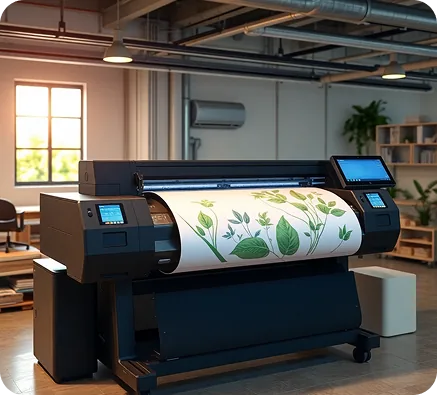
Eco-solvent printing uses a solvent-based ink that cures into a durable, UV-resistant finish, which is why it holds up well against Bangalore's sun and rain. It runs on cast or calendared vinyl up to 3.2m wide, and it is the process behind most of the vehicle wraps, wall decals, and outdoor posters we produce. Because the ink cures into the material rather than sitting on top of it, eco-solvent prints resist fading and scuffing better than many alternatives, making it a dependable default for anything that lives outside for months or years.
UV Flat-Bed Printing: Direct to Rigid Materials
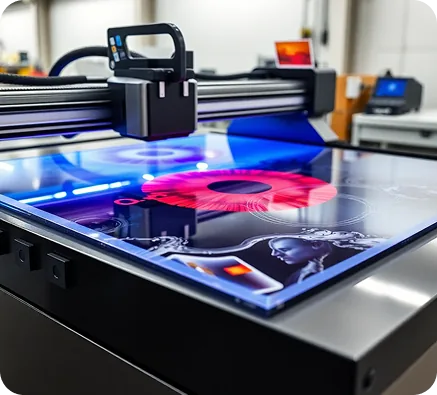
UV flat-bed printing sends ink straight onto a rigid sheet, curing it instantly under UV light. There is no need to laminate a printed vinyl sheet onto a board afterward. That makes it the right call whenever the finished piece needs to be a solid, self-supporting object: acrylic signage, wood panels, glass partitions, or metal plates. Because the substrate does not need to be pre-cut into rolls, flat-bed printing also suits one-off or irregular-sized jobs efficiently.
UV Roll-to-Roll Printing: Built for Scale
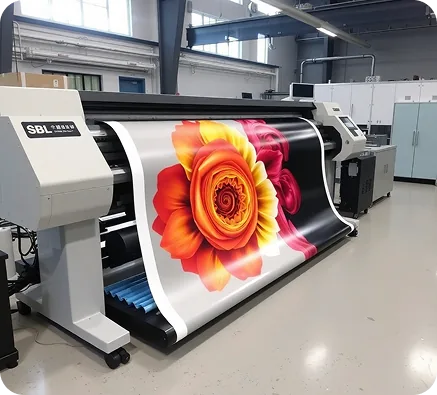
UV roll-to-roll printing keeps the instant-cure advantage of UV ink but runs on flexible rolled media instead of rigid sheets, which is what makes it suited to genuinely large-scale, high-volume jobs like billboards and hoardings. It also handles backlit and light-transmission materials well, which matters for illuminated signage. If a project needs many square metres printed quickly and consistently, roll-to-roll UV is usually the more efficient choice over flat-bed.
HP Latex Printing: Odour-Free and Indoor-Safe
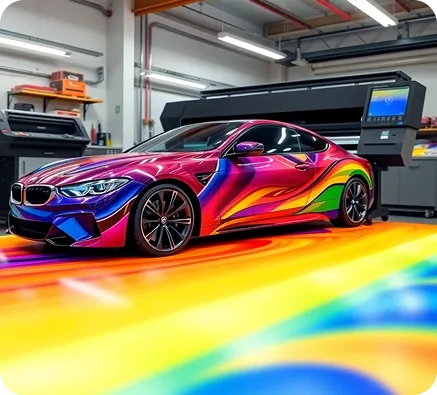
HP Latex ink is water-based rather than solvent-based, so it dries odour-free -- a real advantage for printing that will hang in an occupied office, retail floor, or reception area right after production. It also supports lamination for floor graphics, which need a harder-wearing surface than wall-mounted prints. If the piece is going indoors and will be installed or viewed shortly after printing, HP Latex is usually the more comfortable option for everyone in the room.
How to Decide
- Going outdoors and needs to last years, not months? Eco-solvent or UV roll-to-roll, depending on scale.
- Needs to be a rigid, self-supporting object (acrylic, wood, metal, glass)? UV flat-bed.
- Large-scale campaign, billboard, or hoarding? UV roll-to-roll.
- Going up indoors, in an occupied space, soon after printing? HP Latex.
- Still not sure? Tell us the material, size, and where it is going, and we will recommend the right process.
See the full breakdown on each process: Eco-Solvent Printing, UV Flat-Bed Printing, UV Roll-to-Roll Printing, HP Latex Printing, and Large Format Printing.
FAQ( 01 )
Eco-solvent printing is the usual choice for outdoor banners -- it cures into a UV-resistant finish that holds up against sun and rain, and runs on vinyl up to 3.2m wide. For very large banners or hoardings, UV roll-to-roll is often more efficient at scale.
Both use instant-cure UV ink, but flat-bed prints directly onto rigid sheets like acrylic or wood with no pre-cutting needed, while roll-to-roll prints onto flexible rolled media and suits large-scale, high-volume jobs like billboards.
Yes. HP Latex ink is water-based and dries odour-free, which is why it is the process we recommend for prints going up in occupied indoor spaces shortly after production.
Yes -- eco-solvent prints work indoors too, though HP Latex is often preferred indoors specifically for its lack of odour during and after printing.
UV flat-bed printing can go directly onto acrylic, wood, glass, metal, foam board, and several other rigid materials without a separate mounting step.
Our eco-solvent printing runs up to 3.2m in width, which covers most banner, wrap, and wall-decal jobs in a single continuous print.
Eco-solvent printing on cast vinyl is the standard choice for vehicle wraps, since cast vinyl conforms well to curved panels and eco-solvent ink resists fading in direct sun.
Yes -- share your material, size, and where the piece will be used through our quote form, WhatsApp, or a call, and we will recommend the right process before you commit to anything.