Mesh Banner & Perforated Vinyl Printing: Cutting Wind Load on Big Banners
Large, exposed surfaces like a building under construction or a long perimeter fence are exactly where a standard solid banner struggles most, because wind gets under it and pulls at every grommet and tie point. Mesh banners and perforated vinyl were developed to solve that specific problem: both are printable materials with thousands of tiny openings that let air pass through instead of catching it like a sail. For businesses putting branding on construction hoardings, building wraps, fence lines, or outdoor event structures around Bangalore, understanding the difference between these porous materials and ordinary vinyl can mean the difference between signage that survives a monsoon squall and one that tears off its frame.
What Mesh and Perforated Vinyl Actually Are
A mesh banner is made from PVC-coated polyester woven into an open, criss-crossed grid, so the finished sheet is part solid vinyl coating and part open hole. Perforated vinyl works on a related but distinct principle: it is closer to an ordinary self-adhesive vinyl film, but punched with a uniform pattern of small circular holes across its entire surface, usually applied to glass or window surfaces rather than stretched like a banner. Both materials rely on the same underlying idea — reducing the amount of continuous, airtight surface — but mesh is built for open-air, wind-exposed structures while perforated vinyl is built for one-way visibility through glass.
Airflow, Wind Load, and Why It Matters for Wraps and Hoardings
A solid vinyl banner acts like a sail: wind pressure has nowhere to escape, so it transfers load straight into grommets, ropes, and the mounting frame, which is why solid banners on exposed scaffolding or fences are prone to ripping or pulling loose in gusty conditions. A mesh banner's open weave — commonly around 30% open area, though this varies by product — lets a significant portion of wind pass straight through the material instead of pushing against it. That lower wind load is precisely why mesh is the default choice for building wraps, scaffolding covers, and fence-line hoardings, all of which present a large, continuously exposed surface to the wind for weeks or months at a stretch, including through Bangalore's windier pre-monsoon and monsoon months. Perforated vinyl offers a related but different benefit on glass: its holes let people inside a space see out even though the outside view shows a solid printed graphic, so it is used more for privacy and one-way vision than for wind relief, though it still allows some airflow where used over louvered or ventilated glazing.
Types and Open-Area Ratios
Both materials come in different open-to-solid ratios, and picking the right one is mostly about balancing visibility against wind performance or privacy. Mesh banners are typically sold with roughly 60/40 to 70/30 vinyl-to-open-area ratios; a higher solid percentage gives richer, sharper print detail but reduces airflow benefit, while a more open weave sheds more wind at some cost to color vibrancy and fine text legibility. Perforated vinyl for windows is generally categorized by similar ratios — around 50/50, 60/40, and 80/20 — where a 50/50 film is the most see-through from inside (best for situations needing maximum interior visibility, such as vehicle glass) and an 80/20 film is more opaque and offers more UV and heat blocking, closer to a privacy film with graphics layered over it.
Materials, Printing Process, and Specifications
Mesh banner stock is specified by weight (commonly quoted in ounces per square yard, such as 8 oz mesh, though Indian suppliers often reference it by GSM) rather than by thickness alone, and it is usually reinforced along the edges with hems and grommets or pole pockets the same way a solid vinyl banner would be. Perforated window vinyl is a thinner adhesive-backed film designed to be mounted flush against glass. Both materials are commonly printed using eco-solvent, UV-curable, or latex inkjet processes — the same large-format printing technologies used across most sign and banner work — with UV-stable inks generally recommended for anything that will sit outdoors for an extended period, since fading shows up faster on a surface that is already partly transparent. Bangalore print providers such as Dazzle Creations, which run large-format eco-solvent, UV flatbed, UV roll-to-roll, and HP latex printing lines, typically produce mesh and perforated vinyl output on this same equipment rather than needing a separate dedicated press.
Common Uses and Applications
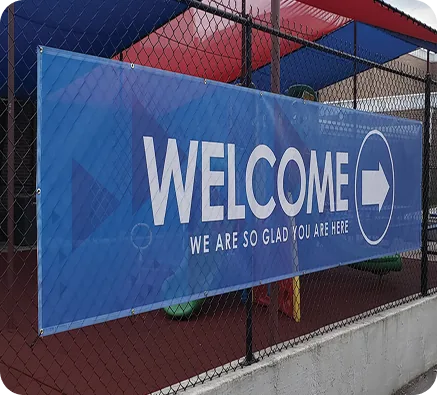
The clearest use case for mesh is anywhere a large surface needs to be covered for an extended period in an exposed, windy location: construction site hoardings and building wraps (where a project's branding or render needs to cover scaffolding for months), fence wraps around sports grounds, compounds, or event perimeters, and temporary structure covers at outdoor events where gusts are a real risk. In a fast-growing construction market like Bangalore — with ongoing commercial and residential projects across Whitefield, Electronic City, Marathahalli, and similar corridors — mesh building wraps are a practical way for developers and brands to turn a construction boundary into advertising space without the maintenance headaches of a solid banner tearing loose. Perforated vinyl's main uses are storefront windows, office and retail glass frontages, vehicle windows, and glass-fronted site offices or sales galleries, anywhere a business wants an outward-facing graphic while keeping the interior able to see out and stay shielded from direct sun.
Choosing the Right Material, Durability, and Maintenance
The main trade-off to weigh is wind exposure and intended lifespan against image quality: mesh and perforated vinyl both sacrifice some color saturation and fine-detail sharpness compared to solid vinyl, so they work best for bold logos, large type, and simple graphics viewed from a distance rather than intricate close-up artwork. On lifespan, mesh banners are generally rated for shorter outdoor service than heavier solid or blockout vinyl, so for a long construction project it is worth asking a supplier about the specific material weight and inks used rather than assuming all mesh performs the same. Maintenance is modest but matters: periodic cleaning to prevent debris building up in the open weave, checking grommets and ties for UV degradation (these often wear out before the printed sheet does), and re-tensioning after heavy wind events will meaningfully extend the usable life of either hoarding or wrap. For most Bangalore businesses planning a build-and-cover job or a windy outdoor event, it's worth speaking with a local large-format provider — Dazzle Creations among them — about expected exposure duration and wind conditions before settling on a specific open-area ratio and material weight.
For large-format print production including mesh and perforated vinyl output, see our large-format printing page, or compare it with other substrates in our printing methods comparison.
FAQ( 01 )
A mesh banner has thousands of tiny perforations that let air pass through, while a regular vinyl banner is a solid, non-porous sheet. This makes mesh far more wind-resistant and less prone to tearing or pulling loose, at some cost to color vibrancy and fine print detail.
Construction wraps cover large, exposed surfaces for weeks or months at a time, and a solid banner that size would act like a sail in the wind. Mesh's open weave reduces that wind load significantly, making it far less likely to rip free of scaffolding or framing.
Outdoor lifespan depends on material weight, ink type, and exposure, but mesh generally has a shorter rated life than heavier solid or blockout vinyl banners. Hardware like grommets and ties often degrade from UV exposure before the printed mesh itself does.
Perforated vinyl is a punched adhesive film applied to glass, mainly for one-way window graphics on storefronts and vehicles, so people inside can see out while the outside shows a printed design. Mesh is a woven banner material built for open-air structures, not glass application.
It depends on the goal: a more open ratio (such as 50/50) maximizes visibility through glass or sheds more wind on a banner, while a denser ratio (such as 80/20) gives sharper print detail and more privacy or UV blocking at the cost of some airflow or see-through quality. A printer can recommend the right ratio based on where and how the material will be installed.
Yes, both are commonly printed using eco-solvent, UV-curable, or latex large-format inkjet processes, the same technology used for standard vinyl banners and signage. Bold graphics, logos, and large text reproduce well; very fine detail and small text are better suited to solid vinyl.
Yes, mesh is a common choice for event fencing, perimeter wraps, and temporary structure covers specifically because it handles wind gusts better than solid banners, reducing the risk of a banner tearing or a structure being pulled over in a storm.
Mesh banners can typically be finished with hems, grommets, pole pockets, and cut-to-size edges, similar to standard vinyl banners, to suit different mounting methods on fences, scaffolding, or frames.
Perforated and more solid-ratio window films do reduce direct sunlight and UV exposure coming through glass, which can also help reduce interior heat buildup, though the exact reduction depends on the specific film's open-area ratio and should be confirmed with the product specification.
Several large-format printing providers across Bangalore handle this work using eco-solvent, UV, or latex printing equipment, including Dazzle Creations, which offers large-format, UV, and eco-solvent printing services for businesses across areas like Koramangala, Whitefield, Electronic City, and HSR Layout.